Purchase a Research Grade Telescope page 9 of 11
 However great the tracking of the HD200C German Equatorial Mount
and the chosen "autoguiding" CCD camera work together or separately, - the system will fail to track
properly if it is not in "Polar Alignment". The best method to get a proper Polar Alignment is
"The Drift Method". It begins with a rough alignment obtained with a "Polar Alignment Scope".
The same alignment scope is used again to fine tune the polar alignment it first produced. This
is an iterative process where each subsequent iteration improves upon the results of the previous
iteration. Thus a good alignment scope is a must. My telescopes come with an 8 X 50 illuminated
reticle Polar Alignment Scope from Parallax Instruments.
However great the tracking of the HD200C German Equatorial Mount
and the chosen "autoguiding" CCD camera work together or separately, - the system will fail to track
properly if it is not in "Polar Alignment". The best method to get a proper Polar Alignment is
"The Drift Method". It begins with a rough alignment obtained with a "Polar Alignment Scope".
The same alignment scope is used again to fine tune the polar alignment it first produced. This
is an iterative process where each subsequent iteration improves upon the results of the previous
iteration. Thus a good alignment scope is a must. My telescopes come with an 8 X 50 illuminated
reticle Polar Alignment Scope from Parallax Instruments.
Most Research Grade Telescopes are used while connected to a
computer, and the astronomer sees the image on his computer's monitor. However, if the telescope
is to be used to train budding Astronomers, - manual operation is a must. To this end, the
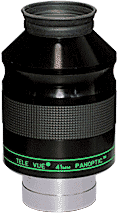
telescope is equipped with a set of TeleView Eyepieces
and Barlow lenses that cover the bottom, middle, and top focal length of all four telescope
ranges.
All in all, I produce six "Acubright" 10" Teaching Telescope
models, and fifteen "Acubright" 12" Comet Chaser Telescope models. These are broken down
into tabular form according to their features on the next page. Please note that all the
McKerron-Newtonian types are guaranteed to have a Total System Wavefront Error of 1/8 Peak to
Valley at 550 nm or less, while all the Standard-Newtonian types are gauranteed to have a
Total System Wavefront Error of 1/12 Peak to Valley at 550 nm or less. The former is 2X better
than "Diffraction Limited Optics" while the latter is 3X better than "Diffraction Limited Optics",
- as total systems.

