Purchase a Research Grade Telescope page 8 of 11
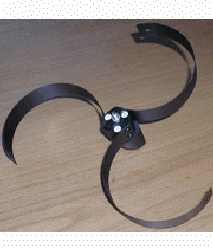 As the Transparent Spider is costly to make with the required
wavefront error, I also make two 10" f: 5. 4 Standard Newtonian model telescopes
and five 12" f: 4. 0 Standard Newtonian model telescopes with various CCD camera sets
that all feature spiders that have 3 curved vanes for Astrophotographic applications.
Here, the pair of bright spikes associated with each vane that emanate from the image's bright
spots, are made "invisible" by spreading their brightness over the entire image, slightly degrading
image contrast.
As the Transparent Spider is costly to make with the required
wavefront error, I also make two 10" f: 5. 4 Standard Newtonian model telescopes
and five 12" f: 4. 0 Standard Newtonian model telescopes with various CCD camera sets
that all feature spiders that have 3 curved vanes for Astrophotographic applications.
Here, the pair of bright spikes associated with each vane that emanate from the image's bright
spots, are made "invisible" by spreading their brightness over the entire image, slightly degrading
image contrast.
For strictly scientific applications I make two 10" f: 5. 4
Standard Newtonian model telescopes and five 12" f: 4. 0 Standard Newtonian model
telescopes with various CCD camera sets that all feature spiders that have
4 straight vanes. This gives the
enhanced stability of the fourth vane. The locations of the objectionable bright spikes
are controlled by rotating the telescope tube in its mounting by special
Rotating Rings. Here a part of the image
obscured by a bright spike can be uncovered by rotating the spike away from that part of the image, -
without degrading image contrast.
Without a ccd camera, all the above telescopes are limited in
their Resolving Power by the quality of the Atmospheric Seeing. However, the image shifting
capabilities of these cameras that gives them the ability to "autoguide" also imparts the ability
to correct for positional shifts of the image due to poor atmospheric seeing. Thus the AO7 software
from SBig lends all my telescopes all the benefits of "Adaptive Optics" when capturing images.
Note: This type of adaptive optics cannot improve upon poorly formed images
resulting from poor grade mirrors.

