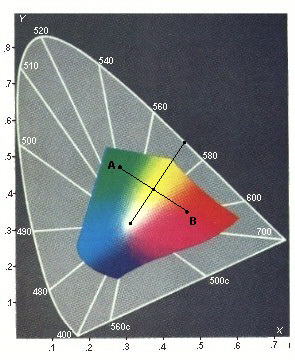
 Color mixing can be achieved by joining the
X-Y coordinates of both colors with a line. Every point on that line represents
a possible mix, with its proximity to either color representing that color's
portion of the mix,-as a percentage of this line's length.
Color mixing can be achieved by joining the
X-Y coordinates of both colors with a line. Every point on that line represents
a possible mix, with its proximity to either color representing that color's
portion of the mix,-as a percentage of this line's length.
It may be pointed out that every color can be
seen as the possible mix of a multitude of color pairs. This makes this method
far superior to any other method I know of.
It also explains the workings of
Dr. Land's Two Color Experiment that allows us to get a full color image from
a pair of Black and White negatives of the same scene shot through two different
color filters. When these negatives are projected onto the same screen with a pair of projectors, through another pair of color
filters so that they are superimposed,- The full color scene is reproduced.
The procedure works because the B&W
film is capable of recording the Luminosity of all the colors in the scene, and
a color's Luminosity will alway coincide with its Chromacity. The system
provides two Wavelengths for every color. Recombining the two
sets of luminosities through both color filters which are now mixed for the
first time,- reproduces the missing original wavelengths and restores the
original chromacities of the original scene.

