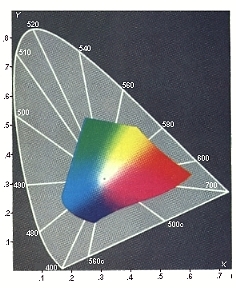
 The best way to clear up the confusion is to
describe both lines separately while realizing they are diagramatically the
same line.
The best way to clear up the confusion is to
describe both lines separately while realizing they are diagramatically the
same line.
The dot divides the line into two segments unless
it is placed at either end of the line, which is permissible. When this line
represents "Chromacity" the segment between the dot and the White Point is termed
the color's Excitation Purity. This same segment is termed the color's
Luminous Excitance when the line represents "Luminosity." There are
three terms that apply to the remaining segment: If the line represents "chromacity",
the term for this segment is Saturation. If the line represents "luminosity"
the segment may be termed either as Luminous Transmittance or as
Luminous Reflectance, depending on the source of the colored light. If
the source is direct, the former term applies. If the colored light is reflected
light, it will have "picked up" some of the color of the surface it was reflected
from and the term Luminous Reflectance indicates this fact.

