

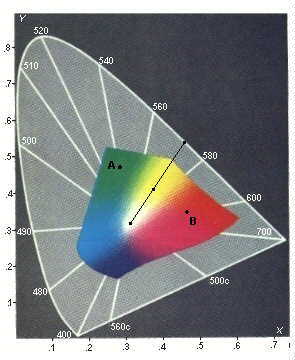
 The first step in mixing colors is to select
the colors to be mixed on the "CEI Chromaticity Diagram" to the right,
and lable them "A" and "B". Then
extend a line through color A's position from the "White Point" to
the curve. This will establish color A's Wavelength, its "Luminous Excitance", and its
"Luminous Transmittance". Next
extend another line through color B's position from the "White Point" to
the curve, in order to get color B's wave-
The first step in mixing colors is to select
the colors to be mixed on the "CEI Chromaticity Diagram" to the right,
and lable them "A" and "B". Then
extend a line through color A's position from the "White Point" to
the curve. This will establish color A's Wavelength, its "Luminous Excitance", and its
"Luminous Transmittance". Next
extend another line through color B's position from the "White Point" to
the curve, in order to get color B's wave-length, "Luminous Excitance", and "Luminous Traqnsmittance". Now Join the two colors with a line from A to B. This line represents all the possible combinations of these two colors. The mid-point between the two colors along this line represents an equal mix of both colors. Draw a line from the "White Point through this mid-point to the curve. The new line represents the color of the mixture. The Point "M" where this line crosses the A-B line, is the "Luminouse Excitance" of the resultant color, which is a Pale Yellow with a wavelength of 568 nanometers.
This agrees with the calculated value of lM
= 2 / (1 / 540e-9 + 1 / 600e-9) = 568e-9 meters or 568 nanometers. Tremendous! It means
we can normalize invisible colors and apply their known "lumini Excitances" to
determine color mixes that occur within invisible spectrals. Reset.