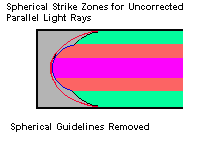
 The approximated parabolic mirror works because
the second spherical section shares the same axis of symmetry. Some of its
inward directed light rays will pass through the focal point created by the first
spherical section. Without the second spherical section, those rays would not
have been reflected through the desired focal point.
The approximated parabolic mirror works because
the second spherical section shares the same axis of symmetry. Some of its
inward directed light rays will pass through the focal point created by the first
spherical section. Without the second spherical section, those rays would not
have been reflected through the desired focal point.
By adding more spherical sections between the
two existing spherical sections, more of the incomming parallel light rays can
be diverted through this common focal point. When enough spherical sections
are added to reflect all the incomming parallel light rays through the common
focal point, the approximated parabolic curve will coincide with the true
parabolic curve,- resulting in a true parabolic mirror.
It is the numerous inward directed rays that
do not pass through the desired focal point that concern us. Many of these
rays that have crossed the axis of symmetry from the inner spherical section,
meet similar rays from the outer spherical section before those rays leave
their outer strike zone,- forming partial focal points in the outer
spherical section's strike zone. This is coma error.

