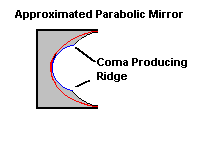
 If we look at the cross section of the approximated
parabolic mirror with the burden removed, and without showing the colored spherical
strike zones, we can view the mirror as a parabolic mirror with a ridge formed
by the seam of the two spherical sections. The smaller the telescope's
Focal Ratio, the more pronounced the ridge. This is due to the steeper curves
required to make shorter focal length mirrors. The optician who polishes this
ridge away while figuring his mirror, will produce an approximated parabolic
mirror with an infinite number of spherical sections,- a true parabolic mirror.
If we look at the cross section of the approximated
parabolic mirror with the burden removed, and without showing the colored spherical
strike zones, we can view the mirror as a parabolic mirror with a ridge formed
by the seam of the two spherical sections. The smaller the telescope's
Focal Ratio, the more pronounced the ridge. This is due to the steeper curves
required to make shorter focal length mirrors. The optician who polishes this
ridge away while figuring his mirror, will produce an approximated parabolic
mirror with an infinite number of spherical sections,- a true parabolic mirror.
With this mirror at the bottom of a closed
telescope tube, off-axis objects are not presented to the mirror, and if the
telescope is geometrically collminated, there will be no source of coma in the
entire telescope system. Thus a pure Newtonian Telescope, of any Focal Ratio,
can be produced completely free of coma error without the need of a coma correcting
eyepiece.
Many telescope makers rely on the myth that
coma error is inherant in the design of all Newtonian telescopes so they can
sell you a telescope with a cost effective, incompletely figured mirror. A
fine optical instrument worthy of their hefty price. Of course you will need
their higher priced coma correcting eyepieces to go with it.

