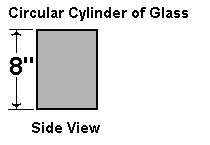
 The diagram at the left shows how the approximated
parabolic mirror is formed out of two spherical sections. The Grey area is the
glass, the Red curve is the Parabolic Curve being
approximated, the Black Curve is a segment of the
Larger Outer Sphere, and the
Blue Circle is the Inner sphere.
The color bands show the zones
controled by different areas of the mirror's surface.
The diagram at the left shows how the approximated
parabolic mirror is formed out of two spherical sections. The Grey area is the
glass, the Red curve is the Parabolic Curve being
approximated, the Black Curve is a segment of the
Larger Outer Sphere, and the
Blue Circle is the Inner sphere.
The color bands show the zones
controled by different areas of the mirror's surface.
In a True Parabolic Mirror, all incomming parallel
light rays striking the mirror will pass through a single common focal point
along the mirror's axis of symmetry. This is not true for Spherical Mirrors.
All spherical mirrors require the assistance of a Corrector Plate, which bends
the incomming parallel light rays so that when they strike the mirror's surface
they will be reflected through a single common focal point along the mirror's
axis of symmetry.
Without a Corrector Plate, a spherical mirror
will bring many incomming parallel light rays to a common focal point along the
mirror's axis of symmetry. However, it will reflect most of those incomming
light rays inwards to cross the axis of symmetry at numerous points all along that
axis. Reset image to Glass Blank.

