|
Telescope Mounts
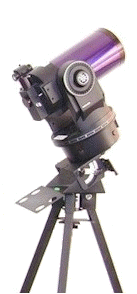
Put a wedge between an Alt-azimuth mount and its supporting
tripod, and you get a
Fork Equatorial Mount.
This type of equatorial mount gives you all the many benefits of an equatorial mount with the
simplicity of an alt-azimuth design. Its main drawback being it is not suitable to long focal
length optical tubes. This is because the optical tube must be able to swing down through the
opening between the optical tube's hinge, and the base from which the forks arise. The angle of
the wedge should equal the user's latitude. The
German Equatorial Mount
eliminates this problem allowing the mount to support very long focal length optical tubes.
Equatorial mounts with "Clock Drives" have been in use for many
decades. A simple clock motor on the polar axis allows the telescope to track an object across the
sky without a second motor on the "Declination" axis, and without a computer. Even dual-motor,
computer-controlled telescopes track better on properly set up equatorial mounts. Once an
equatorial mount has been properly set up, the mount's "Setting Circles" can be used with any of
the many star catalogues to locate thousands of catalogued stellar objects.
|

