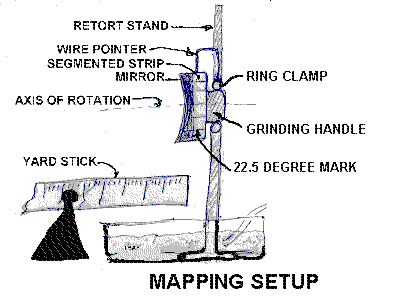
When done, advance another 22 1/2 degrees, and
repeat the proceedure. You can do this 15 times. before you are back to your
starting radial.
Rather than using a protracter to measure the
rotation of the mirror on its axis, a 31.42" X 1/4" paper strip is divided into 16
equal segments and glued to the mirror along its circumferance.
I used a thin piece of hook-up wire as a pointer,
firmly attached to the ring clamp, in which the lens was rotated about its own axis.
I also constructed a table in which I recorded the
results of each foucult test. Whenever the foucult test failed, I would determine
if the actual focal point was ahead of or behind the desired focal plane. Thus
in my table I would put a '+' a '-', or a '.' in the table for the test results.
I never had a single '-' in the table, and fortunately,
most of the results were '.' signifying right on. The few '+'s I got were all on
one of two radials that marked a single diagonal across the mirror. This served
to encourage me considerably, because all the '+'s fell so neatly onto a single diagonal.
Of course I could identify the diagonal and apply longer polising strokes to its
two radials.
