he main requirements for this test are the
same as for the quick test for radius of curvature. Only you need to make off
axis measurements at the desired center of curvature. To do this you must be
able to measure distances at right angles to the mirror's central axis out to
at least the mirror's radius of 5", on both sides of the mirror's central axis.
A pair of steel 12" rulers were available and proved very useful.
For this test, you place the rulers at right
angles to the yard stick at half the distance out from the mirror to the
measured center of curvature. One ruler is placed on one side of the central
yard stick, and the other ruler is placed on the other side of the yard stick.
The formation resembles a cross. The rulers are now located in the mirror's
focal plane and measure distances away from the mirror's central axis
along the mirror's focal plane, on either side of the central axis.
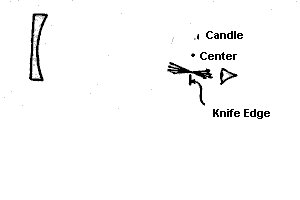 With a little care, you can mount the candle
at a known distance away from the central axis, so that the candle is also in
the mirror's focal plane.
With a little care, you can mount the candle
at a known distance away from the central axis, so that the candle is also in
the mirror's focal plane.
The image of the candle should come to a focal
point in the same focal plane, at the same distance out from the mirror's central
axis on the opposite side of that axis. Knowing this, you place a Razor Edge
just a little further out along the focal plane where you expect the focal point
of the image to be, and place your eye behind the expected focal point.
Now you carefully move the Razor Edge in along
the focal plane towards the central axis, and observe what happens as the razor
edge cuts through your focal point.
The lens should darken evenly all over, and appear
flat if the mirror is perfectly spherical. Also, moving the knife edge slightly across
this point should not cause a moving shadow across the face of the mirror.
If the mirror is not spherical, the mirror will
not darken evenly all over, will not appear flat, and a shadow of the razor's
edge will move across the face of the mirror.

