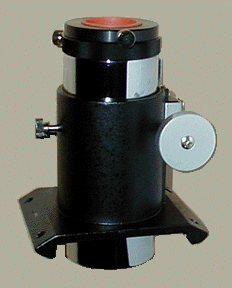
 Good "Rack and Pinion" focusers will have a draw tube that is longer
than the 2" travel required. This is because we don't want the rack to disengage the pinion in
the extreme focus positions. Much of the quality of these focusers depends upon
how the pressure of the "Focusing Lock's" set screw is applied to the draw tube. It can be anything
from the end of the screw itself through to a curved pressure plate, or even a variable diameter
collar. The pitch of the thread on the rack, and number of grooves on the pinion will
determine the coarseness of the focus control.
Good "Rack and Pinion" focusers will have a draw tube that is longer
than the 2" travel required. This is because we don't want the rack to disengage the pinion in
the extreme focus positions. Much of the quality of these focusers depends upon
how the pressure of the "Focusing Lock's" set screw is applied to the draw tube. It can be anything
from the end of the screw itself through to a curved pressure plate, or even a variable diameter
collar. The pitch of the thread on the rack, and number of grooves on the pinion will
determine the coarseness of the focus control.
Also the materials used for various parts of the focuser play a
significant role as to both its durability and stability. The weight of an eyepiece can be as
much as 5 pounds so no part should be over stressed when supporting a load of 7 or 8 pounds.
The ambient temperature change over the course of an evening will affect the coefficient of linear
expansion of the materials used in the construction of the focuser. This change can allow the
system to "creep" out of focus. In general, better materials and workmanship are reflected
in higher prices. You can see quality by knowing what to look for. You can look down the empty
barrel of the focuser's housing to see how the pressure of the "focus-locking" set screw is
applied to the draw tube.

