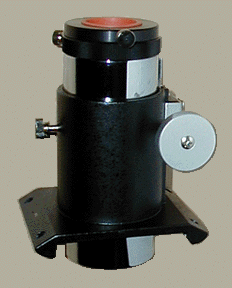
 The "Rack and Pinion" focuser pictured at the left is one of the
earliest designs that has survived because it is simple yet effective. The eypiece is
inserted into the "draw tube" where it is tightened in place by 3 "thumb" screws. The focusing
knobs are at both ends of a longitudinally grooved shaft, called a pinion. This pinion is engaged with a geared
"rack" mounted on the outside of the draw tube so that it fits into a vertically grooved
channel in the focuser's "housing". Whenever the pinion rotates, the draw tube is forced to
move up or down within the focuser's housing according to the direction of rotatation of the
pinion. A large thumb screw on the barrel of the housing can be used to "lock" the focusing
adjustment in the focused position.
The "Rack and Pinion" focuser pictured at the left is one of the
earliest designs that has survived because it is simple yet effective. The eypiece is
inserted into the "draw tube" where it is tightened in place by 3 "thumb" screws. The focusing
knobs are at both ends of a longitudinally grooved shaft, called a pinion. This pinion is engaged with a geared
"rack" mounted on the outside of the draw tube so that it fits into a vertically grooved
channel in the focuser's "housing". Whenever the pinion rotates, the draw tube is forced to
move up or down within the focuser's housing according to the direction of rotatation of the
pinion. A large thumb screw on the barrel of the housing can be used to "lock" the focusing
adjustment in the focused position.
Rack and Pinion focusers come in two major sizes and two styles.
Most amateur telescopes until very recently have a draw tube with an inside
diameter of 1.25". The current trend is towards focusers with a draw tube that has a 2"
inside diameter. These can accomodate both the newer 2" eyepieces, and with an adapter, the
large variety of 1.25 eyepieces currently available. Of course the outside diameter of the
draw tube closely matches the inside diameter of the focuser's housing to prevent any wobble.
The two styles are: "regular" and "low profile". These styles apply
to other "types" of focusers as well.

