pherical aberration affects both refractors and
reflectors, although it is more prevalent in reflectors due to improperly figured
mirrors. Remember figuring a mirror changes the circular curve to a
parabolic curve, where the focal length of the central region is made shorter than
the focal length of the mirror's outer surface. Some folks don't get
this right, and end up with a focal length for the inner region that is longer
than the focal length for the mirror's outer surface. The very opposite
of what is required.
The cure for this type aberration in a mirror is to figure
the mirror correctly in the first place. If the mirror is thick enough, it is
possible to refigure it, but I wouldn't want to try it myself.
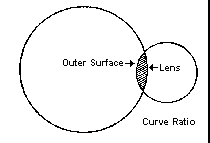
In a refractor, this type of aberration is corrected
by choosing the right curves for the achromat's front element. The radius of
curvature for the outside surface should be 1.5 times smaller than the radius
of curvature of the element's inside, or trailing surface. This applies to
Apochromats as well.