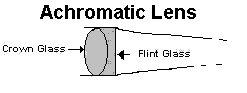
Chromatic aberration can be further corrected by adding another element or two to the doublet. One of these additional elements will be made from an extra low dispersion glass, or from Fluorite glass. Such a lens corrects for three or more colors and drastically reduces the secondary spectrum. This type of lens is called an Apochromat.
Chromatic aberration does not affect reflectors,
so a telescope that uses a mirror as its objective will almost be free from
this type of aberration. Almost? Yes, because most telescopes use
an eyepiece, and eyepieces are refractor type lenses subject to this type of
aberration.

