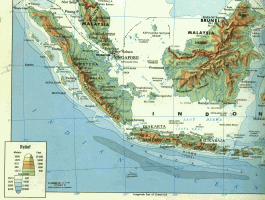
 According to the map of Indonesia at the left, the deep water in
the Indian Ocean is 20,000 feet deep except for in the marked trenches that are deeper yet.
The Hydrostatic Pressure at that depth is:
According to the map of Indonesia at the left, the deep water in
the Indian Ocean is 20,000 feet deep except for in the marked trenches that are deeper yet.
The Hydrostatic Pressure at that depth is:
1.013 X 10
+ [1000 * 9.81 * 20000] = 196,301,300 Pa
196,301,300 * 1.45 X 10
= 28,463.69 PSI.
A 30 foot swell would increase the pressure on the sea floor to the
same value as the Hydrostatic Pressure would be at a depth of 20,030 ft., which is 28,506.36 PSI.
A Texas Instruments 84HP Pressure Transducer operates over the
range of pressures from 15 PSI to 30,000 PSI in temperatures from -40°F to +275°F making
this device the component around which to design my detector.
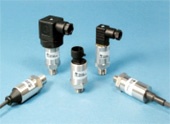 Pictured at the right, this device operates on 5 Volts providing
a full scale output from 1 to 5 volts DC. Coupled to a Voltage Controlled Oscillator in the
audio range, which has its output fed to a linear amplifier that drives an underwater loud-speaker,
the circuitry serves as a Pressure to Sound transducer. The sound wave produced must travel
through a distance of 5 miles to reach the "Sonobuoy" above. This means the amplifier and
speaker must be capable of handling significant power levels, even though sound travels much
better through water than it does through air
Pictured at the right, this device operates on 5 Volts providing
a full scale output from 1 to 5 volts DC. Coupled to a Voltage Controlled Oscillator in the
audio range, which has its output fed to a linear amplifier that drives an underwater loud-speaker,
the circuitry serves as a Pressure to Sound transducer. The sound wave produced must travel
through a distance of 5 miles to reach the "Sonobuoy" above. This means the amplifier and
speaker must be capable of handling significant power levels, even though sound travels much
better through water than it does through air

