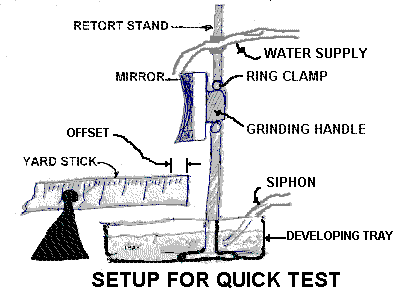
Some means by which distances back to the lens from in front of the lens can be measured even though they are as far away as 10 feet.
A means of keeping the mirror's working surface wet, without making too much mess.
A point source of light such as a flashlight bulb, (called a candle anyway) and dimly light, use weak batteries
I used a retort stand with some heavy metalic weights at the bottom to hold the mirror. A ring clamp wedged over the grinding handle served to attach the mirror to the stand. The ring clamp could rotate on its own axis, while the clamp could be rotated about the retort stand's vertical axis, giving me enough freedom to allign the mirror with respect to the work bench. A small plumb bob came in very handy
The base of the retort stand was placed in a photographic developing tray, equiped with a siphon. Rubber tubing and varius clamps, were used to transport a small stream of water to the top of the mirror, where the water was allowed to trickle over the face of the mirror to keep it wet. The siphon returned this water to the drain in the work bench's sink.
A pair of Aluminum yard sticks were mounted on edge at a height that enabled the one closest to the mirror to be extended over the top of the "drip tray." The near end of the first yard stick was placed in line with a small mark put on the mirror while it was still a flat cylinder, to show the middle of the mirror's thickness. Half the mirrors original thickness was then subtracted from every measurement as the offset.
This entire assembly became my "optical jig" and the idea was not to disturb it so that errors could be introduced due to tiny differences in subsequent set ups. One set up for all measurements. It was bad enough that the mirror had to be removed and attached from and to the jig numerous times.
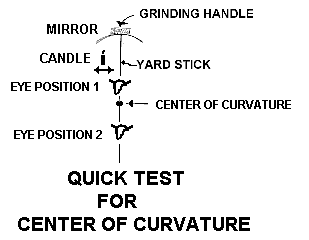
For this test, you place your eye along the mirror's central axis and look towards the mirror from a known distance. You then move the candle back and forth across the surface of the mirror, and observe the direction of motion of both the candle and the image.
When your eye is closer to the mirror than the center of curvature, as in position 1 of my diagram, the candle and its image in the mirror will both move in the same direction.
When your eye is further from the mirror than the center of curvature, as in position 2 of my diagram, the candle's image in the mirror will move in the opposite direction to the candle's movement.
When this occurs, move your eye closer in and repeate the test until you zero in on the actual value of the present Center of Curvature.
Grind, test, grind, test.......As you go through repeated cycles of grinding and testing you will note the Center of Curvature moving inwards towards the mirror and its desired center of curvature.
You should stop rough grinding when this test reveals the center of curvature is about 10 inches further out from the mirror than your desired Radius of Curvature. For my mirror, this point was 118" out from the mirror.
