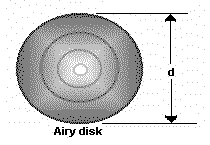
 A good approximation of the above formula for the
diameter of the Airy disk is:
A good approximation of the above formula for the
diameter of the Airy disk is:
d = N / 745 in millimeters
No lens or mirror can produce a spot smaller than
this Airy disk. The brightness within the airy disk is not uniform,
but decreases from the center outwards towards the edge. At the edge, the
brightness is reduced to zero, giving it a characteristic black outer ring.
Rayleigh's famous criterion for acceptable
resolution states that two distinct points are resolved when the dark ring of
one Airy disk coincides with the center of the other Airy disk. This gives
a resolution of:
R = 2 / d in lines per millimeter
Here we can see that as d gets smaller with the
larger openings, the resolution increases.

