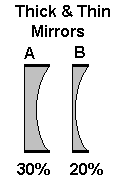
 Which of the two mirrors at the left is more likely to buckle under
its own weight? Most people would answer "Mirror B", - and they would be right.
Both mirrors have the same aperture and Sagitta as I cloned mirror B from mirror A and shortened its
width to 20% of its aperture. Clearly, Mirror B would be classified as a "thin Mirror" and
equally clear, is the need for additional support. Mirror A looks like it can support its
own weight, as indeed it can.
Which of the two mirrors at the left is more likely to buckle under
its own weight? Most people would answer "Mirror B", - and they would be right.
Both mirrors have the same aperture and Sagitta as I cloned mirror B from mirror A and shortened its
width to 20% of its aperture. Clearly, Mirror B would be classified as a "thin Mirror" and
equally clear, is the need for additional support. Mirror A looks like it can support its
own weight, as indeed it can.
The exaggerated Sagitta in this diagram demonstrates the need for
multiple point floatation cells in using "Thin Mirrors" very well. For large apertures, thin
mirrors are a must, for small apertures, "Thick Mirrors" are more desirable, as their supports have
much less influence over their figure, and hence they are likely to have a more uniform wavefront
error over their entire surface area.
For mirrors beyond 20% of their own diameter in thickness, the
Plop program will continue to work, but the deformations calculated just don't happen, because the
equations that suite "Plate Theory" don't apply to the geometry of Thick Mirrors.
Using a multiple point floatation cell to support a Thick Mirror
should not introduce deformations of its own. I intend to conduct a series of tests that will
compare using a 3, 6, and 9-point floatation cell with a Thick Mirror against using the same mirror
supported by other means, - to determine to what extent, if any, a thick mirror's surface figure is
affected by using these floatation cells.

