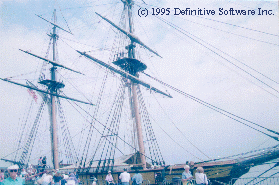
 The US Brig Niagara shown here is almost an exact replica of the original Brig US Niagara, and contains many timbers from the original. This vessel is 12 feet longer than the original, and uses modern materials for the sails and rigging. The Niagara's sister ship, the
 Facing Commodore Perry was Captain Robert H. Barclay who's commissioned rank was only that of a Commander. His flag ship, the HMS Detroit, was 15 feet longer than the Brig Niagara. This is the same ship that was missing its guns and sailing tackle taken at York. It was now fitted out with a motley collection of mismatched land guns from 6 lbs. to 24 lbs. in size and with makeshift rigging. Barclay's second ship was the 17 gun HMS Queen Charlotte. Barclay also had a small brig the HMS Hunter, the schooner HMS Lady Prevost, the one gun schooner Chippawa, and the sloop Little Belt.
In terms of fire power, The British fleet out gunned the American fleet in long range guns. At close quarters these long range guns were feather weights compared to the massive 32-lb carronades of the American fleet. Commodore Perry could deliver a combined salvo of 664 lbs., while Captain Barclay could only deliver a combined salvo of 264 lbs.
Both fleets were woefully short of trained seamen. Commodore Perry had a distinct advantage here, as his fleet was composed of 60% experienced seamen while Captain Barclay had to settle for a fleet made up with only 32% experienced seamen. Captain Elliott of the US Brig Niagara had hoped to command the American fleet on Lake Erie due to the fact he was the only US naval officer to gain any kind of victory up to this point of the war. He was passed over in favour of Commodore Oliver Hazard Perry. That Commodore Perry allowed Lt. Jesse Elliott his hand picked choice of seamen with which to crew the Brig Niagara, was probably a peace keeping gesture on Perry's part. Much to the chagrin of the other fleet commanders, Elliott picked the cream of the crop. This made the US Brig Niagara the only ship on the lake that day to be both properly manned and properly armed.
In a paragraph: The HMS Detroit and HMS Queen Charlotte engaged The Brig Lawrence while the Niagara stood off. All three ships sustained much damage with the Brig Lawrence being reduced to a floating hulk. Captain Elliott then decided to enter the fray, but Commodore Perry wasn't finished, and transferred his colours from the now useless Lawrence to the untouched Niagara. Perry immediately set out to cut through the British line. Barclay recognized the manouver but was, that moment in time, severely wounded by a blast that also mortally wounded his second in command. His attempt to bring the Detroit around to meet this threat failed with his injury. Perry succeeded in the manouver, causing much damage to all the British ships in the vicinity. Barclay's inexperienced men then attempt to maneuver the Detroit and Queen Charlotte into better positions, but managed instead to tangle the two ships hopelessly together. Unable to maneuver or to bear their guns on the enemy, they were sitting ducks for the US Brig Niagara, which pounded them into submission. Meanwhile, Captain Elliott, now in command of the Somers, organized the remaining US fleet into an attack on the remaining British fleet . Following the joint surrender of their flagship Detroit and the Queen Charlotte, the Hunter and the Lady Prevost also surrendered. The Chippawa and the Little Belt both tried to escape but were caught,- making Commodore Perry's victory complete.

