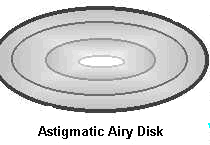
Consider Astigmatism. The minimal sized Airy disk produced by a point source of light by an aberration free mirror is a perfect circle. Introduce astigmatism, and the airy disk will become an ellipse. It won't require a lot of astigmatism to produce an ellipse with a major diameter that greatly exceeds the diameter of the original circle.
Since the telescope's resolution depends on this diameter in such a way that a smaller diameter produces a finer resolution, you don't have to be a rocket scientist to see this amount of astigmatism will decrease the mirror's resolution.
Grainy images don't reveal fine details very well and spherical aberration can also increase the size of the minimal Airy disk. These aberrations are not just unpleasant, they degrade the telescope's ability to show you the universe as it is.
This concludes the section on Optical Aberrations. It is noteworthy to observe how many of these aberrations can be eliminated or drastically reduced simply by taking more care in the grinding and polishing stages.

